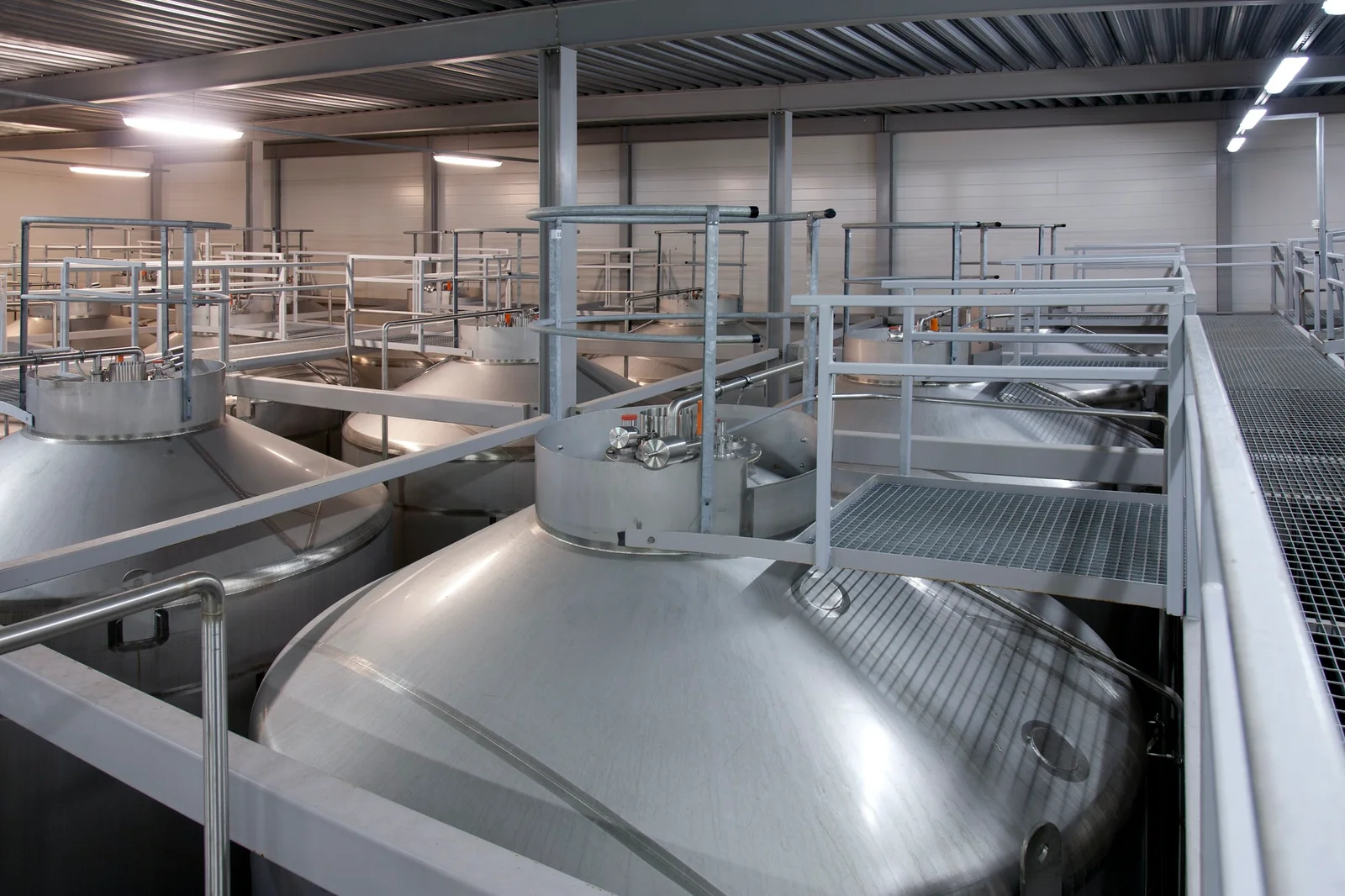
Automated craft beer equipment simplifies brewing by moving repeated control tasks from manual operation to PLC-based sequences. A brewer can store mash rests at 63–68°C, regulate transfer pumps through variable-frequency drives, hold fermentation within a programmed temperature range, and record tank pressure without checking every valve or gauge by hand. A 10–20 hL brewhouse may involve dozens of valve, pump, heating, and timing changes during one brew. Automation keeps those steps repeatable while operators remain responsible for recipes, raw materials, yeast, sensory checks, and exceptions. In commercial production, repeatability matters because even a 2–3°C process deviation can change wort fermentability or fermentation behavior.
A manual brewhouse can make excellent beer, but the brewer has to repeat a long sequence each time. Heating liquor, filling the mash tun, starting agitation, holding a rest, opening the correct transfer route, controlling runoff, starting sparge water, heating the kettle, moving wort to the whirlpool, cooling it, and filling a fermenter can involve more than 30 operator interactions in one batch. On a brewery producing 2 or 3 turns per day, small delays accumulate quickly, which is why automation usually starts with temperature, pumps, and valves rather than replacing every manual task.
Temperature control is often the first area where the difference becomes obvious. During saccharification, many ale recipes operate within roughly 63–68°C, while mash-out may sit near 75–78°C. A PLC receives readings from temperature sensors and controls steam, electric heating, or hot-water flow against a stored setpoint. Rather than watching a display for 45–60 minutes, the brewer can work on another part of production while the control system records the actual temperature and raises an alarm if it leaves the permitted range.
That temperature record also helps when the brewery repeats the same beer 20, 50, or 100 times. A batch that finishes drier than expected can be compared with earlier mash records instead of relying on handwritten notes. If a sensor log shows a mash spending 15 minutes at 69°C rather than the intended 65°C, the brewer has a measurable process difference to investigate. Automation does not explain every quality change, but it gives production staff timestamps and measured values that are difficult to collect consistently by hand.
The same approach carries into liquid movement. A transfer that appears simple may require confirmation of the source vessel, destination vessel, valve route, pump condition, and tank level. Automated valves and pump interlocks can require those conditions before a pump starts. A variable-frequency drive can then operate a centrifugal pump at 30%, 60%, or another programmed speed instead of depending on repeated manual adjustments at the pump or valve.
Interlocks are most useful when they stop an incorrect sequence before liquid starts moving. A receiving vessel with a high-level signal, a closed downstream valve, or a pump without the required permissive can keep the programmed transfer from starting.
Lautering adds another group of variables. Runoff that is too fast can compact the grain bed, while poorly coordinated sparging can change extract collection and pre-boil volume. An automated system can read wort flow, vessel level, pump speed, and differential pressure where the equipment includes the required instrumentation. A 20 hL recipe can therefore use the same runoff sequence on repeated brews instead of asking each operator to reproduce a valve position from memory.
| Process point | Typical information handled by automation | Practical production use |
|---|---|---|
| Mash | 63–78°C temperature ranges, 20–60 minute rests | Repeat stored temperature steps |
| Lauter | Flow, level, pump speed, pressure | Keep runoff and sparging within set limits |
| Kettle | Heating state, time, level | Reproduce boil sequence and addition alerts |
| Fermenter | Temperature, pressure, cooling valve | Follow multi-day fermentation programs |
| CIP | Time, temperature, concentration-related readings, flow | Repeat validated cleaning sequences |
Once wort reaches the kettle, timing becomes easier to standardize. A recipe may call for a 60-minute boil with hop additions at 60, 20, 10, or 5 minutes remaining. The control system can start timers automatically when programmed process conditions are reached and notify the brewer at each addition point. Ingredient handling can remain manual, which is common in craft production, while heating, timing, pump operation, and vessel routing follow the stored batch program.
That division of work matters because not every brewing activity benefits equally from full automation. A 10 hL brewpub producing six rotating beers may prefer manual specialty additions and automated heating, while a 40 hL production brewery repeating several flagship beers may automate most valve routes. Equipment selection works better when it follows actual batch frequency and staffing rather than an arbitrary automation level. Turn-Key brewery solutions can combine vessels, controls, piping, pumps, cooling, and related process equipment within one planned production layout when a brewery wants the systems designed together.
Fermentation extends automation from hours into days or weeks. Ale fermentation may commonly be managed in the high teens to low 20s °C depending on strain and recipe, while lager production can use lower primary fermentation temperatures followed by warmer maturation steps and cold conditioning. A temperature probe, glycol valve, and programmable controller can reproduce those stages without requiring an operator to visit every fermenter several times per shift.
Pressure can be included in the same record. A unitank designed for pressure operation may use a pressure transmitter alongside mechanical safety devices, allowing staff to review both temperature and pressure from the control interface. Alarm thresholds can be set separately from normal process targets. The control system is useful for monitoring, but certified pressure-relief hardware remains a mechanical safety requirement and should never be replaced by software logic.
The benefit becomes larger as tank count grows. Checking 2 fermenters manually is manageable; checking 12 or 24 vessels several times per day creates a different workload. Central monitoring lets one operator see which tank is cooling, which tank has moved outside its programmed band, and which fermentation stage is active. If temperature readings are stored every 1 or 5 minutes, a 7-day fermentation creates thousands of data points without thousands of handwritten entries.
Cleaning is another area where stored sequences remove repeated manual operations. The Master Brewers Association of the Americas describes CIP performance through four interacting variables: time, temperature, chemical concentration, and mechanical action. Its 2024 brewery-cleaning education material also discusses using sensors and PLC systems to measure and control cleaning cycles. A controller can sequence rinsing, detergent circulation, draining, and later rinse stages while checking that required conditions have been reached before the timer advances.
Actual CIP settings must come from the brewery's equipment and chemical program rather than a universal recipe. MBAA industry discussions include examples such as 1.5–2% caustic solutions, 30-minute cycles, and tank cleaning around 60–66°C, but suppliers and brewery engineers may specify different values for soil level, chemical formulation, stainless grade, spray device, and vessel geometry. That variation is exactly where programmable recipes help: an approved 20-minute line cycle does not have to use the same parameters as a 30-minute fermenter wash.
Water use can also be measured rather than estimated. A flowmeter can show whether a rinse consumed 250 L, 400 L, or 600 L, and repeated batch records make unusually long rinses visible. Research presented through MBAA has examined burst rinsing against continuous rinsing because CIP rinsing can consume substantial volumes of water and shorter controlled bursts can reduce unnecessary use under suitable equipment conditions. Automation supplies the timing and valve repeatability needed to apply a validated rinse method consistently.
Maintenance data adds another practical layer. A pump that normally completes a 20 hL transfer in 18 minutes but begins taking 24 minutes deserves inspection for restrictions, impeller condition, valve position, foaming, or process changes. Temperature loops that repeatedly overshoot a 66°C setpoint by 2°C may need tuning, sensor inspection, or changes in heating response. Recorded cycle times make gradual equipment changes easier to notice than a production log containing only batch start and finish times.
Recipe permissions also reduce accidental changes when several people use the same brewhouse. A brewery can allow an operator to start a stored recipe while limiting who can edit a 67°C mash setpoint, a 60-minute boil, or a maximum transfer speed. Batch records can include recipe version, operator login, alarm history, and timestamps, giving managers a clearer production history when a beer is brewed 50 or 100 times across different shifts.
Automation still depends on sound mechanical design. A PLC cannot correct an undersized heat exchanger, a temperature sensor installed where it responds slowly, a pump operating outside an appropriate range, or piping that leaves difficult-to-clean dead areas. A system with 100 automated valves can perform worse than a simpler installation if valve feedback, drainage, access, instrumentation, and maintenance were poorly planned.
For the same reason, more automation is not automatically better for every brewery. A 5 hL pilot system may need only automated temperature control and a few variable-speed pumps, while a 30–50 hL production brewhouse may justify automatic routing, recipe control, flow measurement, batch logging, and integrated CIP. The useful question is how many repeated operator tasks occur per brew and how much production depends on reproducing them across 2, 5, or 10 batches in a working week.
Staff still need manual operating modes because sensors fail and production conditions change. If a level transmitter gives an incorrect reading or an automated valve loses air pressure, an experienced brewer must know how the process is physically arranged. Good controls show valve state, pump state, measured temperature, target temperature, alarms, and permissive conditions on one screen without forcing the operator through several menus to understand why a sequence stopped.
A brewery planning growth can therefore treat automation as part of process design rather than as a separate electronic upgrade. Vessel sizing, brewhouse turns, fermenter count, cooling capacity, CIP capacity, piping routes, and control points need to match. If production rises from 3 brews per week to 10, reducing repeated manual switching and recording can free staff for yeast management, cellaring, quality checks, packaging preparation, and maintenance while the stored process continues to handle the repetitive sequence.