XPENG in Australia: What the Current Line-Up Covers
Three nameplates sit on the manufacturer's Australian site in September 2026: the L03, listed as coming soon, the New G6 coupe SUV, and the X9 seven-seat MPV. Only two of them carry full published figures, and both of those share the same 800-volt silicon-carbide platform family, a 10-80% charge time of 12 minutes, and a seven-year whole-vehicle warranty.
Key takeaways
- The New G6 publishes up to 525 km WLTP; the X9 publishes up to 580 km WLTP.
- Both quote a 10-80% top-up in 12 minutes on 800-volt architecture.
- Whole-vehicle cover runs 7 years, and key parts including the traction battery run 8 years or 160,000 km.
- Pricing happens offline: the online configurator returns an estimate, then a local dealer issues the quote.
The three nameplates, in the site's own words
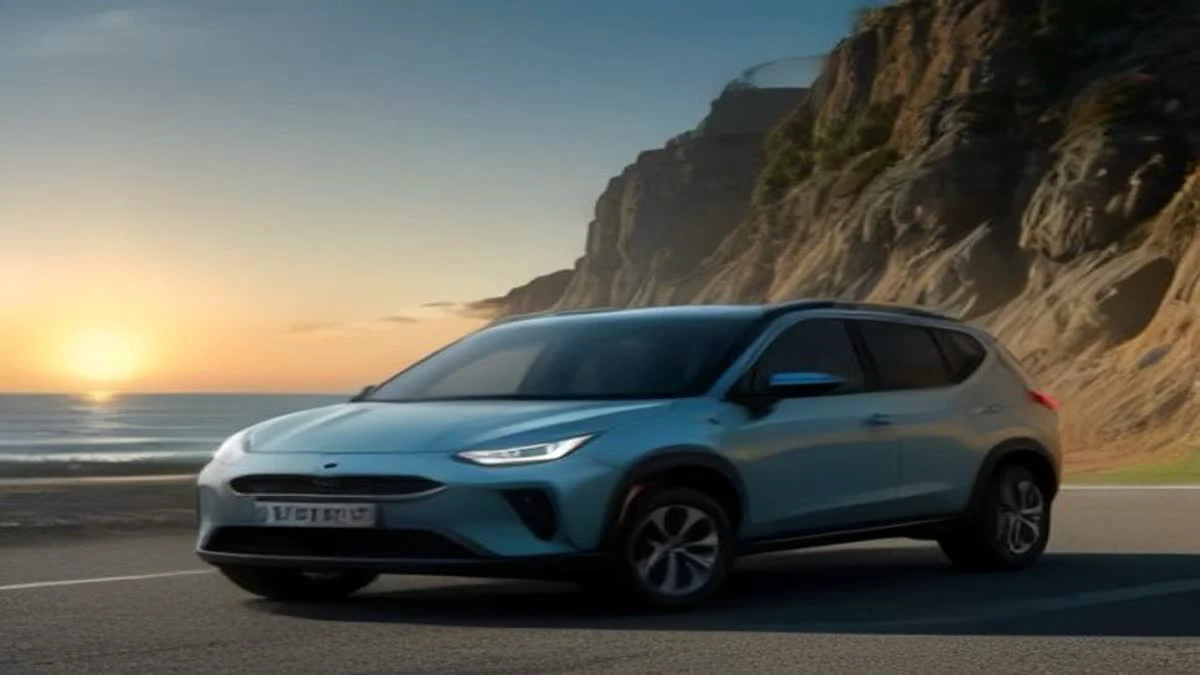
The range page on the XPENG Australia site keeps three names in view, and it is careful about which of them you can order today. The L03 is flagged as coming soon and takes interest registrations rather than configurations. The New G6 is described as the 2026 XPENG G6 smart coupe SUV, an Ultra Smart Coupe SUV in the model page's own heading. The X9 is an Ultra Intelligent 7 Seater MPV. If you want published numbers to compare side by side, the G6 and the X9 are the two that answer.
What the New G6 publishes
The G6 quotes a WLTP range of up to 525 km, with two variants named: RWD Long Range and AWD. A 10-80% state-of-charge charge is published at 12 minutes, and the site headlines its 5C battery as Australia's first, on a Full-Domain 800V High-Voltage SiC Platform. A separate figure of up to 427 km of charge added in 15 minutes carries the site's own footnote: it comes from internal tests of the G6 RWD Long Range. The AWD drivetrain is quoted at 4.13 seconds for 0-100 km/h, and the split between the two is laid out plainly on the New G6 variant page.
Driver assistance is branded XPILOT ASSIST. The site's footnote is explicit that this is an assistance function: the driver must stay aware, monitor traffic and take over when needed. Perception hardware includes XPENG's Full-Stack Lofic Architecture, pairing a front binocular camera with a rearview camera, described as extending visual perception range by 125% over the previous generation and recognising 49 types of obstacles, static and dynamic. Inside, the fastback silhouette is matched to power-reclining Nappa leather seats, and the site notes that seat availability varies by configuration. The cockpit runs Xmart OS, updated over the air through Wi-Fi or mobile network.
What the X9 publishes
The X9 is the seven-seater, with up to 580 km WLTP, a 10-80% charge in 12 minutes and 5.9 seconds to 100 km/h in AWD form. Its practical hardware is where it separates itself: active rear-wheel steering, dual-chamber air suspension with an AI chassis that adapts ride height to speed and offers six levels of manual control, and obstacle detection up to 30 m ahead so damping adjusts before you reach the bump. The third row folds flat electrically with one touch, cargo volume expands to 2554 L, and the submerged trunk design is described as fitting seven suitcases with every seat occupied. The X9 model page lists those features one by one, which makes it the quicker read if you are weighing a seven-seater against a five-seater.
The L03 and the buying path
No published price list exists for the L03, and none for the other two either, because the Australian site does not publish prices at all. The route it describes runs from the online configurator, where you build the vehicle and receive a price estimate, to a local dealer who provides the formal quote, the contract and the test drive. Dealer tools named on the site include Find a Dealer, Test Drive, Build My XPENG and Owner Connection. If the L03 is the one you are waiting for, registering interest is the step that puts you on the list.
Charging, and what the daily routine asks of you
Both cars publish the same headline charging figure: 10-80% state of charge in 12 minutes on the 800-volt platform, with the G6 badge describing 5C battery technology. In practice the daily routine is slower and cheaper, because most owners charge overnight at home rather than chasing a rapid charger. The published notes are worth knowing before your first cable: XPENG vehicles are compatible with most public Type 2 AC and CCS2 DC fast chargers, and the charge flap sits on the right rear quarter panel, where you press the top-left corner of the flap before connecting. Some Tesla Supercharger sites in Australia are open to non-Tesla CCS2 vehicles, and the site advises checking the Tesla app for site compatibility, because not every site supports cars from other brands. Home charging features include plug-and-charge, a charging schedule and an anti-theft locking function, and the site's own high-power charger is described as a 480 kW unit with a 670A+ flow rate, liquid cooling and IP67 protection. If you see network figures of 772 branded supercharging stations, 1,870 free charging stations and 319 cities quoted for XPENG, note that those describe the network in China rather than Australia.
Warranty, servicing and roadside cover
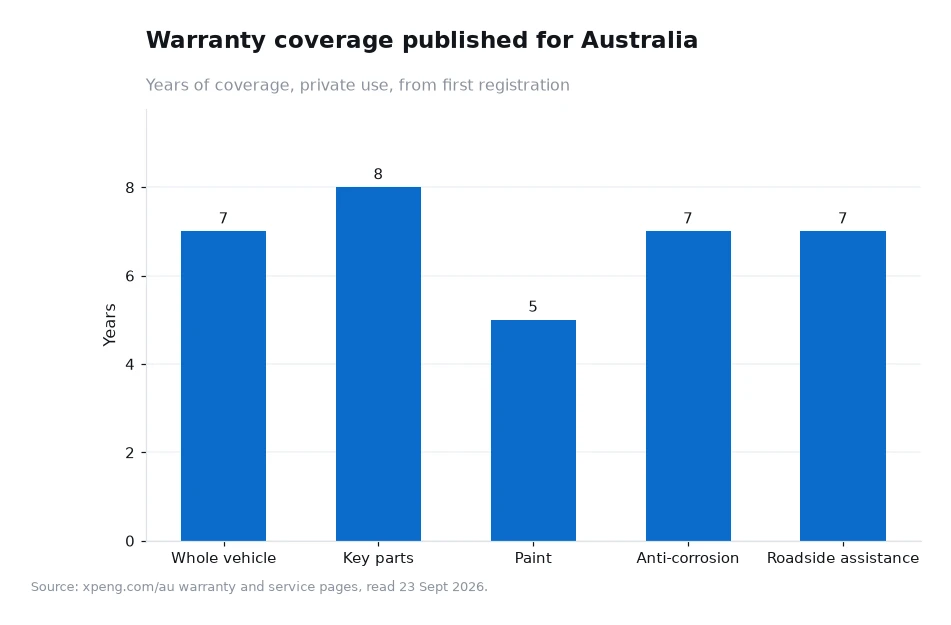
Ownership terms are published in plain numbers. The whole vehicle is covered for 7 years, unlimited kilometres for private use, or 160,000 km for commercial use. Key parts, meaning the traction battery, battery management system, drive motor and intelligent power unit, run 8 years or 160,000 km, whichever comes first, and that cover provides at least 70% of the battery's original capacity, with gradual capacity loss described as normal for traction batteries. Paint is 5 years unlimited kilometres and anti-corrosion 7 years unlimited kilometres. Roadside assistance runs 7 years from first registration on 1800 255 494, with 24/7 coverage across the majority of Australia. Scheduled maintenance falls every 12 months or 20,000 km, whichever arrives first, through an XPENG Authorised Dealer. Terms sit in the XPENG ANZ Warranty and Maintenance Manual for Australia, and support now comes directly from XPENG ANZ.
| Item | Published term |
|---|---|
| Whole vehicle, private use | 7 years / unlimited km |
| Whole vehicle, commercial use | 7 years / 160,000 km |
| Key parts, including traction battery | 8 years / 160,000 km |
| Paint and anti-corrosion | 5 years / 7 years, unlimited km |
| Roadside assistance | 7 years from first registration |
Worked example: seven years of cover in kilometres
This is an illustrative example, not manufacturer data. Assume you drive 15,000 km a year. The whole-vehicle term of 7 years unlimited kilometres is governed by the calendar, so 7 x 15,000 km = 105,000 km of driving sits inside that term. Key parts are 8 years or 160,000 km, whichever comes first: 8 x 15,000 km = 120,000 km, short of the 160,000 km cap, so the calendar ends that cover first as well. To reach the 160,000 km cap within 8 years you would need 160,000 / 8 = 20,000 km a year. Servicing follows the same whichever-comes-first logic: at 15,000 km a year the 12-month interval always arrives before the 20,000 km mark, giving 7 scheduled services across 7 years. Drive 25,000 km a year and the 20,000 km trigger fires first instead, which works out to 160,000 / 20,000 = 8 services over the same 8-year key parts window.
Frequently asked questions
How many XPENG models can you buy in Australia in 2026?
The Australian site lists three models. The L03 is marked as coming soon, with interest registered rather than orders taken. The New G6 coupe SUV and the X9 seven-seat MPV are the two published in full, with WLTP range figures of up to 525 km and up to 580 km respectively.
Is the traction battery covered by the warranty?
Yes, within the key parts term. That cover runs 8 years or 160,000 km, whichever comes first, and includes the traction battery, the battery management system, the drive motor and the intelligent power unit. It provides a minimum of 70 per cent of the original capacity during that period, and gradual capacity reduction is described as normal for traction batteries.
Where to start your shortlist
Begin with the two models that publish numbers, then decide whether you need five seats or seven. The G6 suits a buyer chasing the coupe silhouette and the published 4.13-second AWD figure, while the X9 suits a household that wants a third row and 2554 L of flexible cargo space. Either way, the next practical step is a test drive arranged through the dealer tools on the manufacturer's site.
Specifications, warranty terms and service intervals quoted here come from the manufacturer's Australian website as read on 23 Sept 2026. Option availability such as Nappa leather seating varies by configuration, and WLTP range depends on conditions. Confirm current terms with a dealer before ordering. [1]